Recreational Sidemount Diving Course
Here is the ultimate breakdown of what to expect when shifting your tanks to your sides.
 1. Most Recognized Scuba Organizations
The two heavy hitters for recreational sidemount training worldwide are:
-
PADI (Professional Association of Diving Instructors): Offers the PADI Sidemount Diver specialty. It is highly streamlined for recreational, non-decompression diving.
PADI+ 1 -
SDI (Scuba Diving International): Offers the SDI Sidemount Diver course.Known for its practical, modern approach, bridging the gap between recreational and technical mindsets.
Big Blue Tech
(Note: If you have technical aspirations, TDI —SDI’s technical sister agency—offers an advanced version that introduces technical multi-tank management).2. Course Duration & Prerequisites
 2.Prerequisites
-
Minimum Certification: Open Water Diver (or equivalent). Note: Some dive centers prefer Advanced Open Water to maximize depth or wreck training environments.
Robin Hood Watersports -
Minimum age: 15 years old.
Robin Hood Watersports -
Fitness: Standard diver medical clearance required.
Dive Right Pattaya Scuba Technicians & IDEST Training Center
 3. Duration
Expect a 2 to 3-day course , which typically includes:
-
Digital eLearning / Academics.
-
1 Confined Water (Pool) session to dial in equipment fit and basic trim.
Assava Dive Resort -
3 to 4 Open Water training dives.
Dive Careers
 4. What’s Involved in the Course?
The learning curve in sidemount is mostly on land and in shallow water, focusing heavily on gear customization and fine-tuning.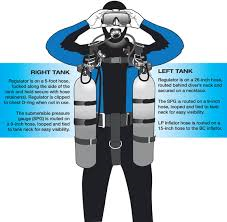
-
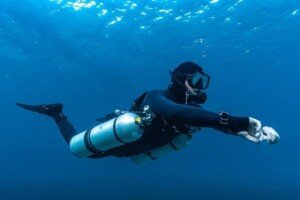
Equipment Fitting: Modifying the harness bungee lengths and hardware placement so the tanks rest perfectly parallel to your torso.
-
Propulsion & Trim: Mastering the frog kick , modified flutter kick, and helicopter turns.Sidemount forces your body into a perfectly flat, horizontal position (“trim”).
SDI | TDI -
Cylinder Management: Learning to clip and unclip tanks on land, at the surface, and underwater. You will practice “swinging” the tanks forward to navigate tight spaces.
Big Blue Tech -
In-Water Drills: Managing two independent gas supplies, swapping regulators, handling “out-of-air” scenarios using a long hose, and shutting down a leaking valve (valve drills).
Tech Dive Thailand
 5. Equipment Needed
Sidemount gear is highly specific and modular. You cannot use a standard jacket BCD or a traditional regulator set.
-
Sidemount Harness & BCD: A minimalist harness with a bladder system (like the Apeks WSX or XDeep Stealth) that keeps the lift centered over your lower back/hips.
-
Dual Regulators: Two independent first stages.The right tank features a long hose (5 to 7 feet) for air-sharing, while the left tank features a short hose on
 a neck bungee. Each needs its own Submersible Pressure Gauge (SPG).Dive Careers+ 1
 -
Dedicated Cylinders: Usually a pair of Aluminum 80 (cu ft) tanks fitted with left- and right-handed valves (mirrored valves) and hardware clips.
-
Proper Weighting System: Weights are usually distributed down the spine of the harness to keep you perfectly balanced.
Robin Hood Watersports
 6. Planning the Dives
Because you are using two completely separate tanks, dive planning changes fundamentally:
-
No Cross-Over: Your left tank cannot talk to your right tank. If one fails, you only lose that tank’s gas supply.
-
The 1/6th or Rule of Thirds: You must balance your consumption. You switch regulators back and forth throughout the dive to keep the pressure in both cylinders roughly equal (usually within 30 bar / 500 psi of each other). This ensures the tanks remain neutrally buoyant and your physical balance isn’t thrown off by a heavy tank on one side.
-
Logistics: Planning entries and exits based on environment. For example, on a rocky shore or small boat, you may choose to enter the water unencumbered and have your buddy pass your tanks down to you.
 7. Risks Involved
While sidemount is incredibly safe when executed properly, it introduces a few specific risks:
⚠️ Task Loading: Managing two pressure gauges, two regulators, and constantly tracking gas balance significantly increases your mental workload compared to standard single-tank diving.
-
Gas Mismanagement: Forgetting to switch regulators can lead to breathing one tank down to empty while the other remains full—ruining your balance and cutting your reserve gas margin in half.
-
Valve Management Mistakes: Because the valves are tucked under your armpits, it requires flexibility and memory muscle to correctly identify and shut down the proper valve during a simulated leak.
-
Entanglement Risk: The extra bungees, clips, and hoses can catch on things if they aren’t tucked away and streamlined properly.
8. Essential Planning Variables
Before splashing, a sidemount diver calculates these core variables:
| Variable | Description | Recreational Metric |
|---|---|---|
| Gas Matching | Ensuring both tanks contain the same mix and volume. | Typically matching twin Aluminum 80s with Air or Nitrox. |
| Switch Intervals | How often you switch regulators to balance your tanks. | Every 30 bar (approx. 500 psi) consumed. |
| Buoyancy Shift | Tracking how the tanks shift from negative to positive as they empty. | Aluminum tanks float at the bottom; clips must be moved forward to keep them down late in the dive. |
| Turn Pressure | The exact gauge pressure where the dive must end to maintain a safe reserve. | Calculated via the Rule of Thirds or a strict Rock Bottom gas calculation. |

