
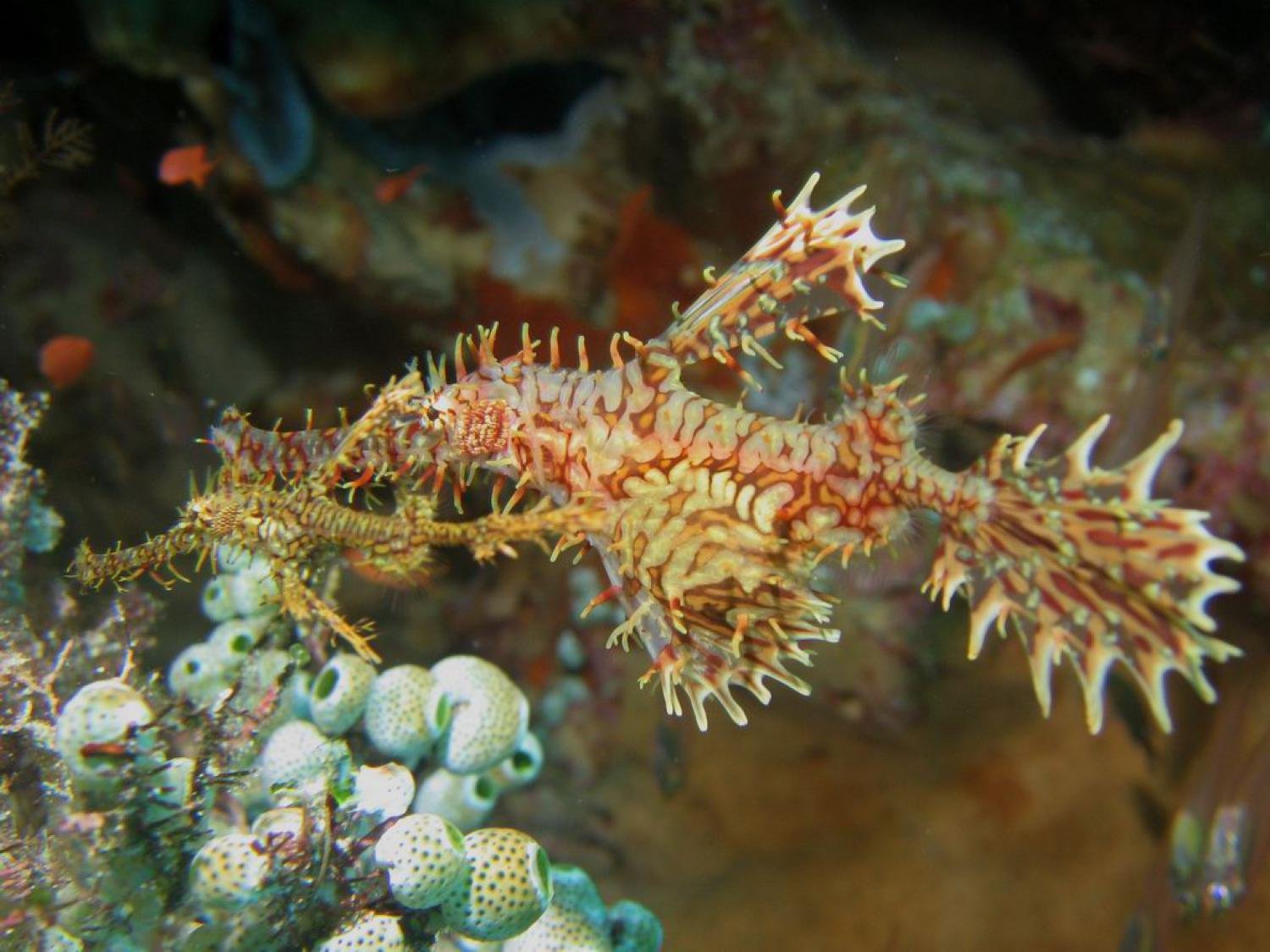
 1. Habitats & Geographic Distribution
Pipefishs are predominantly marine dwellers, though a small number of species have adapted to brackish or freshwater environments (Wikipedia, n.d.). They enjoy a vast geographic distribution, spanning the shallow coastal waters of both tropical and temperate zones worldwide (Wikipedia, n.d.). Because they are relatively weak swimmers, pipefish rely heavily on sheltered, low-energy aquatic environments (Great Southern Reef, n.d.). They are most commonly found camouflaged among:
-
Seagrass and eelgrass beds * Coral reefs * Seaweed and kelp forests near jetties or shorelines (Great Southern Reef, n.d.)
While they typically reside in shallow waters, some species have been documented living in open waters at depths reaching up to 400 meters (Vedantu, n.d.).
 2.Diet, Hunting & Feeding Habits
Diet
The pipefish diet consists primarily of small, slow-moving or drifting organisms. Depending on the size and maturity of the fish, their food preferences shift from tiny planktonic organisms to slightly larger prey: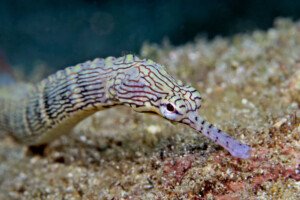
-
Juveniles (<20 mm): Consume mostly copepods (Wainwright & Richard, 1995).
-
Maturing Individuals (20–50 mm): Transition to eating amphipods (Wainwright & Richard, 1995).
-
Adults (>50 mm): Feed on decapod shrimp, small crustaceans, and occasionally tiny larval fish (A-Z Animals, 2022; Wainwright & Richard, 1995)
 3. Hunting Strategy
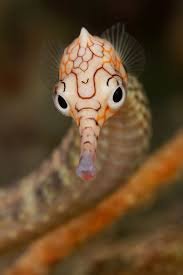
Pipefish, alongside their seahorse relatives, are famous for a highly specialized stealth hunting method known as pivot feeding (de Lussanet & Muller, 2007, as cited in Royalsocietypublishing, 2009).
-
The Approach: Because their rigid bodies prevent them from chasing down fast prey, pipefish rely on incredible camouflage to blend in with surrounding vegetation, slowly edging toward a target.
-
The Strike: Once close enough, the pipefish utilizes an elastic-recoil mechanism in its head anatomy to rapidly rotate or “flick” its long, tubular snout upward toward the prey at extreme speeds (ResearchGate, 2015).
-
The Suction: Simultaneously, it creates a powerful buccal expansion, acting like a vacuum to suck the prey into its toothless mouth instantly (ResearchGate, 2015).
 4. Pedators & ecological
Because they are small and slow, pipefish are opportunistic prey for larger predatory fish, wading seabirds, and crabs. However, their primary survival threats stem from environmental degradation rather than natural predators.
Ecological Threats
-
Habitat Loss & Fragmentation: Because pipefish often have narrow regional distributions and rely completely on structural habitats like seagrass and seaweed, coastal development, dredging, and mooring lines severely impact their populations (Great Southern Reef, n.d.; Pollom et al., 2021).
-
Water Mismanagement: Freshwater and estuarine species, such as the Critically Endangered estuarine pipefish (Syngnathus watermeyeri), are highly vulnerable to human water diversion and river mismanagement which disrupts critical freshwater influxes (Pollom et al., 2021).
-
Climate Change & Pollution: Rising ocean temperatures, ocean acidification, and chemical runoff damage the delicate coral reefs and seagrass ecosystems pipefish depend on for survival (ResearchGate, 2022).
 5.Species Diversity
Pipefish belong to the family Syngnathidae, which also includes seahorses and seadragons (Project Seahorse, 2021).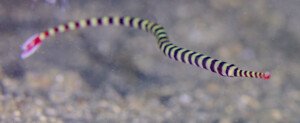 There are well over 200 known species of pipefish globally, making them highly diverse in form. They range in size from tiny species measuring just a few centimeters to the greater pipefish (Syngnathus acus), which can reach lengths of nearly 45 to 50 centimeters. Their bodies are uniquely encased in armored, segmented rings of bony plates, and they display an incredible array of colors and skin filaments designed to mimic local flora.
Pipefish exhibit one of the most fascinating reproductive strategies in the animal kingdom, characterized by sex-role reversal.
6. Breeding Habits
The Courtship Dance
Pipefish exhibit an unusual reproductive strategy known as male pregnancy where the females deposit eggs into a brood area on the male, who then fertilizes, incubates, and “gives birth” to the fully formed fry. This unique system reverses traditional gender roles, with females actively competing for males
Mating begins with an elaborate, synchronized courtship ritual. The male pipefish initiates a ballet-like dance, moving in unison with the female (Australia Remastered, 2021). This synchronized courtship behavior is believed to trigger and align the female’s reproductive hormones (Australia Remastered, 2021).
Male Pregnancy
Unlike most animals, female pipefish must compete for the attention of males (Save Our Seabed, 2022).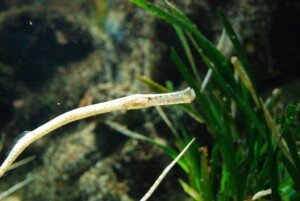 Once a pair successfully courts, the female deposits her eggs into a specialized area on the male’s body—depending on the species, this could be a fully enclosed brood pouch or exposed on his trunk/tail (Project Seahorse, 2021).
The male fertilizes the eggs inside or on his body and nurtures them throughout the gestational period, supplying oxygen and nutrients (Save Our Seabed, 2022). Once the embryos hatch, the male “gives birth” to live, independent young. In some species, the father continues to provide parental care by allowing the tiny juveniles to retreat back into his pouch when danger threatens (Save Our Seabed, 2022).
Mating Systems
Pipefish species show vast behavioral flexibility across their diversity. Some species practice strict, long-term monogamy, remaining with a single partner for life, while other species are polygamous, with males or females mating with multiple partners throughout a single breeding season (Project Seahorse, 2021).
References
-
Pollom, R. A., Ralph, G. M., Pollock, C. M., & Vincent, A. C. J. (2021). Global extinction risk for seahorses, pipefishes and their near relatives (Syngnathiformes).
-
Wainwright, P. C., & Richard, B. A. (1995). Predicting patterns of prey use from morphology of fishes. Developments in environmental biology of fishes, 97-
You can watch this beautiful footage detailing the male animal that can give birth to see a visual breakdown of the synchronized courtship dance and how the male pipefish cares for its young.

