
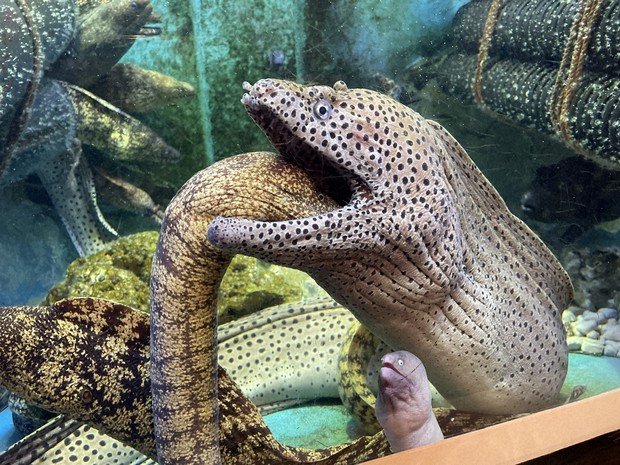
Moray eels (family Muraenidae) are some of the most recognizable predators on the reef, known for their serpentine bodies and “alien-like” second set of jaws. While they are often found in the Andaman Sea (West Coast of Thailand), several key species are also permanent residents of the Gulf of Thailand.
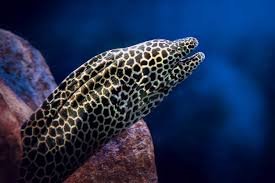
I have summarized the species diversity, local inhabitants of the Gulf, and their unique feeding mechanisms below.
1. Global Species Diversity
There are approximately 200 to 230 recognized species of moray eels worldwide. They are divided into two subfamilies:
Muraeninae (Common Morays): The largest group, featuring dorsal and anal fins that run the length of the body.
Uropterygiinae (Snake Morays): Smaller group where the fins are restricted to the very tip of the tail.
2. Species in the Gulf of Thailand
The Gulf of Thailand’s environment—characterized by shallower, more turbid waters compared to the Andaman Sea—supports a specific variety of morays. Common sightings include:
Common Name Scientific Name Description
Giant Moray Gymnothorax javanicus The largest in mass; brownish with black specks that form leopard-like spots in adults.
Honeycomb Moray Gymnothorax favagineus Also called the Laced or Leopard Moray; white/yellow body with large black blotches.
White-eyed Moray Gymnothorax thyrsoideus A smaller, beige species with distinctive white eyes; often found in small groups in the same crevice.
Highfin Moray Gymnothorax pseudothyrsoideus Brownish body with mottled spots and a noticeably tall dorsal fin.
Fimbriated Moray Gymnothorax fimbriatus Light-colored body with dark spots; known for a more yellowish/greenish head.
Yellow-edged Moray Gymnothorax flavimarginatus Similar to the Giant Moray but with a yellow/orange tint to the eyes and tail margins.
Zebra Moray Gymnomuraena zebra Rare in the Gulf; features dark brown and white vertical bands. Unlike others, it has blunt teeth for crushing shells.
3. Feeding Habits and Mechanisms
Moray eels are apex nocturnal predators with a “sit-and-wait” (ambush) hunting style, though they will actively prowl the reef at night.
The “Alien” Jaws (Pharyngeal Jaws): Morays cannot create suction to swallow food like most fish. Instead, they have a second set of jaws in their throat. When the front jaws grab prey, the pharyngeal jaws reach forward into the mouth, seize the prey, and pull it down into the esophagus.
Olfactory Hunting: Morays have very poor eyesight but an incredible sense of smell. Their large, tube-like nostrils allow them to detect chemical cues from wounded or hiding prey in total darkness.
Cooperative Hunting: In a rare cross-species partnership, Giant Morays have been observed hunting alongside Coral Groupers. The grouper signals the eel to flush prey out of tight crevices, and the two share the “flushed” fish.
Dietary Specialization:
Piscivores: Most (like the Giant Moray) have long, needle-sharp, backward-curving teeth to grip slippery fish and octopus.
Durophages: Species like the Zebra and Snowflake Morays have blunt, pebble-like teeth specialized for crushing the shells of crabs, shrimp, and sea urchins.
The “Knot” Technique: If a moray catches a prey item too large to swallow, it can tie its own body into a “sliding knot.” By pulling its head through the loop, it creates enough leverage to tear off manageable chunks of meat.
Safety Note: While generally shy, morays may bite if they feel cornered or if they mistake a diver’s fingers for food (often due to their poor vision and the practice of illegal fish feeding). Their bites are prone to infection due to the bacteria present in their mouths.

