
The Secret Life of Garden Eels
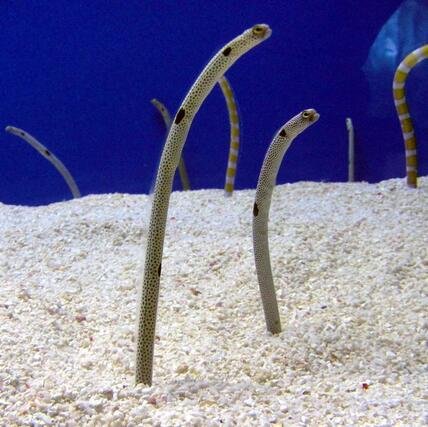
Garden eels (subfamily Heterocongrinae) are some of the most peculiar residents of the tropical seafloor. Living in vast colonies that look like a field of swaying grass, these creatures have evolved highly specialized behaviors to survive in open, sandy environments.
 Habits and Behavior
Garden eels are famous for their sedentary, vertical lifestyle.
-
The Burrow: Each eel lives in a permanent, silk-lined burrow. They secrete mucus from their tails to cement the sand grains together, preventing the walls from collapsing.
-
The “Vanishing” Act: They are extremely shy. At the first sign of a predator or a large shadow, the entire colony retreats backward into their holes in a synchronized wave, making the “garden” disappear instantly.
-
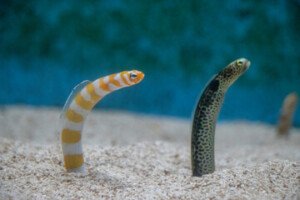
Social Structure: While they live in large groups (sometimes numbering in the thousands), they are quite territorial. Males will often lean out of their burrows to snap at neighbors who get too close to their personal space.
 Diet and Hunting
Garden eels are planktivores, meaning they feed on tiny drifting organisms.
-
Passive Hunting: Unlike many eels that scavenge or hunt fish, garden eels are “sit-and-wait” predators. They face into the prevailing current, swaying back and forth to snatch passing zooplankton, crustacean larvae, and fish eggs.
-
Large Eyes: They have exceptionally large eyes and keen eyesight, allowing them to spot microscopic prey against the bright, sunlit water of the shallows.
 Breeding and Reproduction
The early life of a garden eel is the only time they are truly “free.”
-
Spawning: During mating season, adult eels move their burrows closer together. They intertwine their upper bodies to release eggs and sperm into the water column.
-
The Pelagic Phase: Once the eggs hatch, the larvae are leptocephali (flat and transparent). They drift in the open ocean as part of the plankton for several weeks or months.
-
Settling: After reaching a certain size, the juvenile eel swims down to the sandy bottom, digs its first burrow, and begins its life as a stationary “plant-mimic.”
 Lifespan
In the wild, determining the exact lifespan of garden eels is difficult due to their reclusive nature. However, based on observations in professional aquariums:
-
Average Lifespan: Most species live between 8 to 15 years.
-
Factors: Their longevity is largely dependent on the stability of their colony and the consistency of the currents that bring them food. In a well-maintained, low-stress environment, some have been known to exceed the 15-year mark.

