
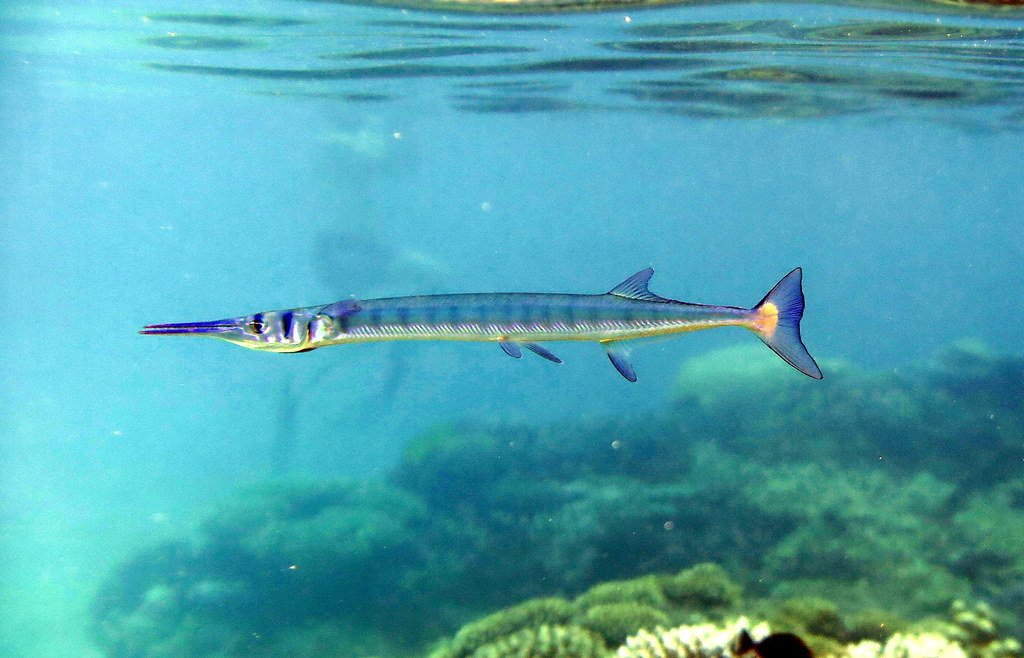
 Habitats
These fish are pelagic (living in the open water column) but prefer staying near the surface.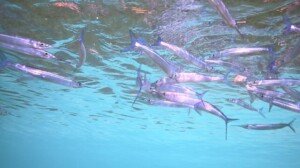
-
Location: Found worldwide in tropical and subtropical waters. They inhabit the Indo-Pacific, Eastern Pacific, and both sides of the Atlantic.
-
Depth: They typically stay within 0–13 meters of the surface, often frequenting lagoons, coastal reefs, and rocky shorelines.
-
Migration: They are “oceanodromous,” meaning they migrate within the ocean, often following schools of baitfish.
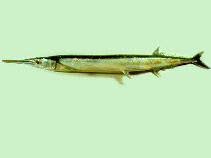 Juveniles vs. Adults
Juveniles exhibit distinct physical differences that change as they mature:
-
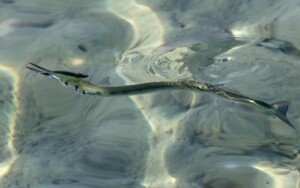
Half-beak Appearance: In very young fish, the lower jaw is significantly longer than the upper jaw. The upper jaw reaches its full length only as the fish nears adulthood.
-
Tooth Direction: A unique identifier for this species is that juvenile teeth point forward, whereas adult teeth and the teeth of other needlefish species are straight.
-
Appearance: Juveniles often have a raised black lobe or blade on the back of their dorsal fin, which disappears as they grow.
 Habits & Behavior
-
Social Life: They are generally solitary or found in small, loose groups.
Surface Dwellers: They spend most of their time hovering or swimming just beneath the water’s surface. -
Acrobatics: They are famous (and feared) for leaping out of the water at high speeds, reaching up to 60 km/h (37 mph). They often jump when startled or attracted by artificial lights at night.
-
Danger to Humans: Because of their “jumping” habit and needle-sharp beaks, they have caused serious puncture wounds and even fatalities to fishermen and boaters.
 Diet & Hunting
The Crocodile Needlefish is a fierce piscivore (fish-eater).
-
Prey: They primarily eat small schooling fish like anchovies, sardines, and mullet, as well as flying fish. They also occasionally consume crustaceans and squid.
-
Hunting Style: They use a “sideways snap” to capture prey. Their streamlined body allows for sudden bursts of speed to ambush schools of fish from below or behind.
-
Juvenile Diet: Before their jaws fully develop, juveniles feed largely on plankton and smaller invertebrates.
 Lifespan & Size
-
Lifespan: Generally estimated to live between 4 to 8 years in the wild.
-
Size: They can grow up to 1.5 meters (5 feet) in length and weigh up to 6.4 kg (14 lbs).
-
Maturity: They typically reach sexual maturity at 2 years of age, when they are roughly 50–60 cm long.
Quick Facts
| Feature | Detail |
|---|---|
| Bones & Flesh | Distinctly green or blue in color (due to the pigment biliverdin). |
| Stomach | They lack a traditional functioning stomach; digestion is handled by the enzyme trypsin in the intestine. |
| Reproduction | Oviparous; they lay eggs with sticky tendrils that attach to floating debris or seagrass. |